Sunday, May 28, 2023

Gallivants I Failed to Blog about (Oman and Qatar 2019, into the new year of 2020)

 Oman and Qatar 2019-20 (how I spent my entire Christmas break and then some). 

This trip was sponsored by Qatar Foundation International where I had been on the first teacher council for the past two years learning about the Middle East with other teachers around the country.  

Highlights from Oman:

First, let me say how much I loved, loved, loved this country!  It is truly so welcoming, beautiful, cared for, interesting, and the list goes on.  I would go back in a heartbeat, especially during winter.  When I was there it was about 72 degrees f, every day!

The national opera house.  An incredibly gorgeous piece of art in itself, inside and out.  I was in awe.  

This seating room is called a majlis.  It is everywhere in the Middle East and where guest gather, have tea or coffee and chat.  We had many moments like this.  This one was not in a home but in a museum.  
Wearing traditional Omani wedding attire.  

The sultan's (at one time) seat and flag of Oman. The dagger is a symbol there, and men pass them on and wear them at weddings and important events. 
In Muscat, the capital.  


At the Sultan Qaboos Mosque.  This sultan, who had ruled since the 70s, modernized Oman, but passed away from cancer shortly after our visit.  
If you see this in a mosque (the quibla wall), this shows the direction of prayer, toward Mecca.
One of our guides showing how the washing is done before prayer. Ahmad was amazing.  He once lived in the U.S. for a time and is married to an American.  
outside the mosque

In a souk (market)
I cannot say enough about how much I love the food in the Middle East.  So fresh and flavorful.
A frankincense tree does really smell like it.  It comes from sap that is dried into a resin.  

At a sinkhole.  
Can I say that Oman is a little like Utah with gorgeous beaches?  You will see why in a bit when you see the canyon and desert pics. 


This melon head on Christmas Eve at the buffet at our hotel was slightly disturbing, but you should have seen the Christmas festivities they had for the western tourists on Christmas Eve!  Music, amazing food, lights, decor!

We went to see if we could see baby turtles hatch, but it was not the season.  Instead we had a traditional picnic on a rug with dates and coffee and good friends.  We also saw amazing stars that night in a clear sky. I will never forget that Christmas Eve across the world where the wise men came from.  
These are dhow boats and an important part of Omani culture and the economy.  We went to a factory where the best ones are made.  One was being made for the Prince of Qatar for the 2022 World Cup.  They are all hand made.  

A wadi.  We went swimming here on Christmas Day.
A family style dinner at a home on our travels. 
About to enter the desert dunes.  
A favorite moment of my life, watching the sun set in Oman on Christmas night.  


Why all white?  Consider the heat in the summer.  Every vehicle is white there.  Literally every one.  
At the glamping desert camp.
My room, which had air conditioning though it was not needed in December. 


We all danced that night to some live music.  Seriously, go dance in Oman.  We laughed so hard. 
A few of us awoke before 5 to catch a total solar eclipse, which was happening about a two hour drive away in the desert.  We watched it happen near this mosque out in the middle of nowhere for the herders.  


Camel riding.  These sweeties have personalities just like your other pets, and this darling was very tender and friendly to me. 


Yes, there was a McDonalds in Nizwa. And we went bowling at the mall. 
The Nizwa Market, famous for its trading of goats and sheep. I also found jewelry for my daughters at the souk at excellent prices. 
At the Grand Canyon of Oman.  A spectacular little hike we took.  
For real, camel crossings are a thing. 

At a UNESCO World Heritage site of an old village and fort. 


Qatar


Qatar Airlines is pretty sweet, as was the suite we enjoyed as guests of Qatar Foundation International
Scenes from the souk in Doha.  This place was amazing and surreal.  Loved every moment there, and the indulging of all five senses. 


Learning to play a traditional game (though this is a custom for men).

One of so many fantastic meals together!  Truly, the cuisine of the Middle East is my 
favorite in the world. 
The National Museum in Doha is designed architecturally to be like a desert rose stone.  
Part of the Doha skyline.


We were invited to one of our QFI guide's (Shahad) home to enjoy a meal together and chat.  What a wonderful experience.  They are originally from Syria and not Qatari. 
The National Library of Qatar


The Museum of Islamic Art is a beautiful building inside and out.  On New Year's Eve, we took a dhow boat cruise around the harbor.  


Inside the art museum.  See what I mean?  It has won numerous prizes for its architecture.

In a beautiful mosque in Qatar where we heard the call to prayer and watched the prayers.  I do feel the inspiration in these grand buildings of the connection to God and the universe. 
Outside the mosque with Qatar's skyline.

In a Persian restaurant.  Nothing in Doha is dull.  It is like Beverly Hills there in the main area.  
At Aljazeera media company.  I respect the free journalism and the perspective AJ offers and have been reading for years, even before this.  
We had henna painting on our last night at the hotel by some experts.  These young women worked fast and produced beautiful work. 
One of my favorite parts of the souk was the falcon market. Every native Qatari family has at. least one pet falcon.  These have been a big part of their culture for centuries.  


Gallivants I failed to blog about (Germany 2019)

 Germany with Transatlantic Outreach Program, July 2019

I had always wanted to apply for the TOP program, as many of many adventurous colleagues in other programs had previously gone with TOP to Germany.  I applied in the winter of 2019 and a couple of months later found out I would be spending 2 weeks with social studies teacher in Germany in July. 

We started in Washington D.C., with an orientation and some cultural lessons at the Goethe Institute, which sponsors TOP, and then flew to Munich, where we started our tour.  We traveled from there up to Nuremberg, then to Geisa in the Fulda Gap, and ended in Berlin.  It was an immensely important experience for me as a world history teacher.  I really should have written more about it, but here were some highlights.

Munich


We met with students on several occasions and participated in class activities.
At Seimens, trying to figure out anything (Seimens was a sponsor of TOP also)
Center of Munich, looking from one of the local towers we climbed. 
One of many stops for a drink in the heat of July
The girls school in Nuremberg created cards for us
At the public park in Munich, such a beautiful green space of many acres.  I took an evening run through here. 

Nuremberg

At the former Nazi Rally grounds.  This place was sobering to think that thousands once raised their arms in the Nazi salute. 

It is a charming city
At the court room where the Nuremberg Trials were held
A walk for international peace
A beautiful cathedral, formerly Catholic, turned Protestant after the Reformation.  This had three incredible organs, and I got to hear a bit of an organ recital. 
Nuremberg is famous for its spaghetti ice, which is gelato pushed through a sieve, basically.  This hazelnut chocolate version had me in a sugar coma for the rest of the day.

With my incredible guides.

Geisa and the Fulda Gap

Geisa is a beautiful city along the Fulda Gap, which is on the eastern most side of the inner German border.  This is where if there had been war declared by the Soviets, their troops would have marched through.  Geisa's citizens had to have paperwork with them all the time, because they could not be within 5 km of the border unless they could show they lived there and were documented.  This area was heavily patrolled, and people tried to escape through this area to the West. 
A woman at the Faber Bakery, which had been in her family for generations.  She told us about what life was like when Germany was divided, and how she and her family had to operate their bakery until the conditions of the East German government. 
Looking out from our hotel, which was really a German lord's hunting lodge at one point.  It was spectacularly beautiful and hard to imagine that this was one of the most intense spots during the Cold War.  
This museum docent lived in East Germany and shared with us a lot of information about the border security.  He took us along the old boarder and showed the different layers of security.  The watchtower below is original.  The dog, as you can probably tell, is fake, but they had layers of mesh fencing, barbed wire, electric fencing, towers, and dogs.  I went running one morning not far from here and never saw another human in that hour until right around our hotel.  It was eery to realize how different it would have been to not be able to venture out 30 years prior, which from 2019 would have been 1989 and the year I graduated from high school!

Looking at Geisa from a watchtower at Point Alpha, the American camp on the west side, looking east.  
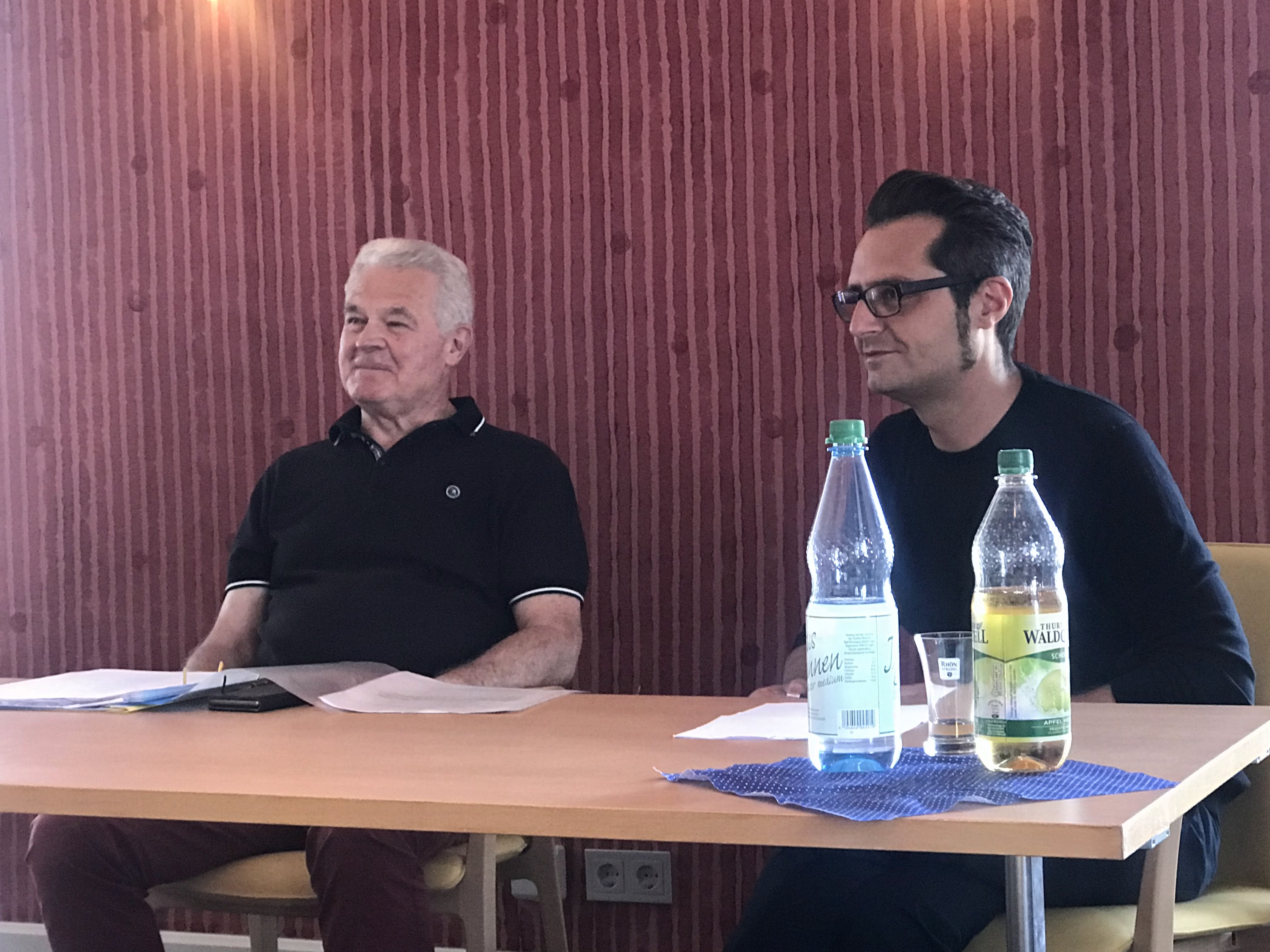
On the left was a former officer of the East Germans.  He spoke to us about some memories.  On the right is one of our guides, Jorge.
We also did a lot of neat cultural activities, like listening to these "horn" players and eat a lot of great German food.  

Berlin

The Bundestag house of Parliament for the German Government.  Much was destroyed during WWII, and it was repaired and has new wings and a new dome you can walk around (cannot see from this photo).
One of the interesting things we learned here was about all of the Russian writing on the walls of the Bundestag to celebrate capturing it at the end of WWII.  It takes some tremendous reckoning with history to keep this (it is now not outside but included on an interior of the building with new parts built around it).  I found it really interesting to see how Germany has dealt with their history and have since had this conversation with students.  
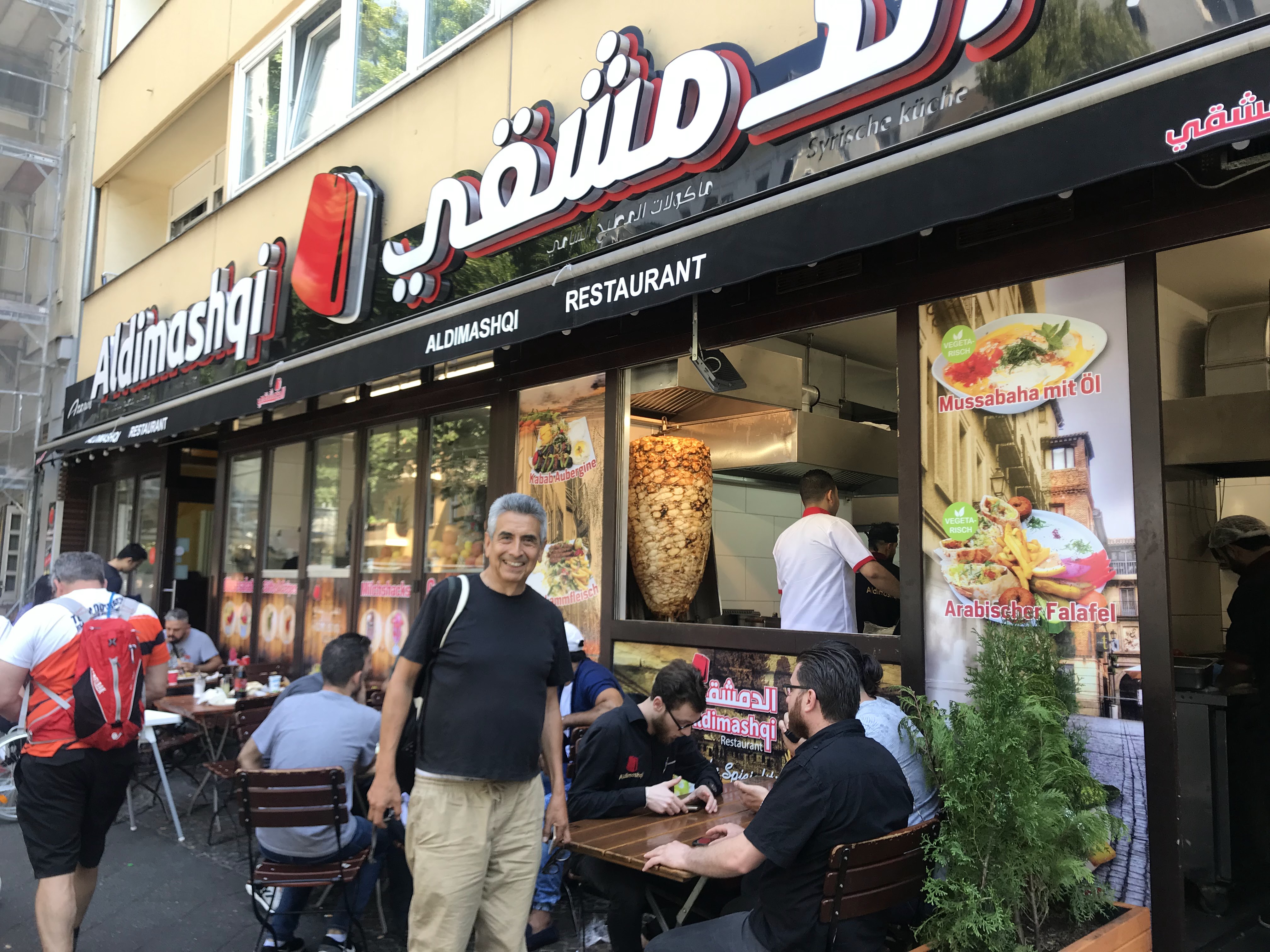
We went to a center that helps refugees find resources.  In 2019, this was close to the years 2015-16 when millions of refugees fled Syria, and many thousands were welcomed (by many) in Germany.  We got to meet with some of them and hear their incredible stories.  This should be an entire blog post, because it was so impactful to me. We also went on a tour of the area in Berlin where many of these refugees live and work and have many shops and restaurants.  My favorite food in the world is Middle Eastern, so it was wonderful to stop here.  


We went to a concert of classical music (some of us) in Berlin's historic center.  It was incredible.  

This is the university and square where Hitler burned thousands of books.  Below is The Empty Library at the Bebelplatz (former Opernplatz) in Berlin, designed by Micha Ullman.  See the links and to this Wikipedia article: https://en.wikipedia.org/wiki/Nazi_book_burnings


At a portion of the Berlin Wall that serves as a large outdoor museum.  The faces on the wall below are of those who lost their lives trying to cross to West Berlin.  

Our final dinner with a diplomat of the German Government was at this building.  
We also did a lot of business visits to show how Germany is working to combat climate change and implement more sustainable practices. This was a community garden right in the city that we toured.