Bursa
Bursa is on the Silk Road. We started our day in the classroom, which is typical when we are already in the city we are touring. We discussed themes of the day and of much of Ottoman culture in general.
These 4 Themes are: 1. Layers of History 2. Religious Diversity 3. Heterodoxy v Orthodoxy 4. Central Authority v Local Power
First, did I pick the right group, or what? Four men and me? You decide. :-)
We then went on a drive up on the mountainside of Bursa, a very large city, where most of the older sites are. The following are photos from the sites, such as the Green Mosque, the Silk Bazaar, etc.
Ulicami Mosque built in 1399. It pre-dates when the Hagia Sofia was taken over by Islam, so there is no dome (a defining characteristic of Turkish mosques). It has remarkable example of Arabic calligraphy inside, and though it has a separate area for women during noon prayers, at other open times women and men can pray in the same area, an unusual thing about Bursa.
The inner fountain is also unusual.
My attempt at a panoramic shot.
This is the direction of Mecca. The pulpit on the right is made of walnut and is all put together with wood, no screws or nails. It is incredibly beautiful. With my other camera I have a close-up shot of the woodwork. It has symbols of the sun, moon and stars.
I never posted a pic with my wonderful roommate Stacey from Florida. She is a kindred spirit.
The Koza Han, the trading market for silk in Bursa, built in 1491. Inside are dozens of shops selling fine silk scarves and other textiles. Will post more photos of the inside later.
For those who wanted more pics of locals.
Next we went to the Green Mosque. There are several mosques called this, but this is the most famous, due to the exceptional green and blue tiles. Somehow, I unintentionally dressed to coordinate with the mosque today.
Women are asked to cover for entering the mosques.
There is much symbolism in the writing and in the plant symbolism. This is all hundreds of years old and goes around the entrance to the mosque.
Note the hexagon or beehive shape. This and squares and triangles are all tessellating shapes, which are godly because they can be extended together infinitely.
The same symbolism we saw a couple of days ago in the houses in Yurukuru and Safronbolu. The number 12 and the hat-like shapes are everywhere. Again, the connections to various religions and even varieties within Islam.
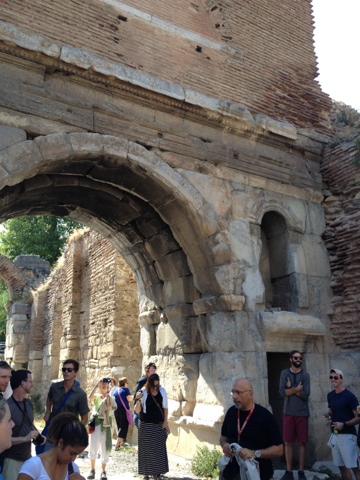
The group gathering outside the Green Tomb. I have to go back to notes and come back to report on who is buried here.
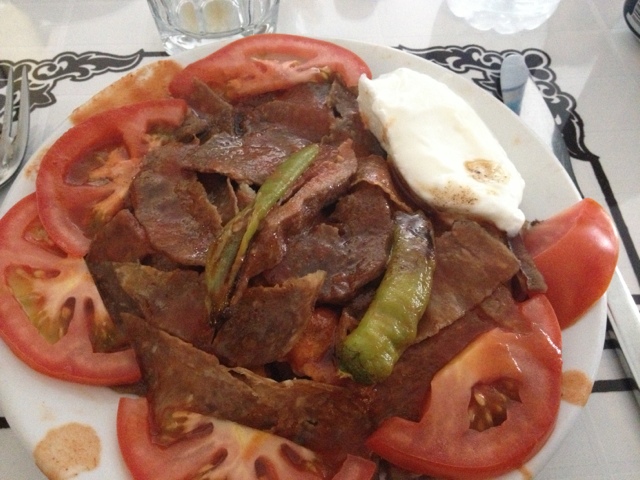
Lunch at Hunkar. This was traditional kabob sliced meat over bread with yogurt. It was scrumptious.
More shopping in Bursa. We found some great items in a multi-tiered store that sold everything from the tackiest souvenirs to beautiful quality linens.
A highlight of the day was watching a traditional shadow puppet show. This was a dying art that has been resurrected over the last couple of decades. This tradition has been around in this part of the world and Indonesia for centuries. The themes include making fun of authorities and usually have a political bent. Though the show was in Turkish, we could understand much of it, and the puppet master threw in some English for our sakes. It was fun to hear the kids laugh. I loved seeing this art form and can see why it has been so popular through the centuries.
These are made from stretched and scraped animal skins, which are then dyed. The parts move.
Back-stage pass after enabled us to see how this was a one-man show. He makes the puppets, and does the movement and voices. I was impressed! What fun!
Osman I tomb. He is the reason we are here, I guess you could say. :-). Is an was not the greatest Sultan but was the founder of what became the Ottoman Empire. I find the hats with the scarves a little strange. Turks do entertaining things. The Turkish flag also cracks me up since the empire really encompassed so much.
Orhan Gazi tomb (Osman's son)
These tiles date back to Byzantine times.
Centuries old Ottoman wall.
Dinner tonight felt oddly wedding or bar mitzva-ish. When it got dark there were these strobing obnoxious neon lights. We were entertained by our fearless leader Barbara telling us funny Riverdance stories. My table was the best.
And finally, for my few friends (you know who you are) who told me not to snatch up a Turkish boyfriend, these are for you. A few of us girls had fun with these guys today. I especially like the mannequin with the turquoise pants and Ataturk shirt. Look up Ataturk on Wikipedia. He is a hero here, and the current Prime Minister, Erdogan, does not like him. He died long ago and is really the one responsible for the modern, more secular Turkish state. We have a game in our group called Ataturk Bingo, which I think is really more like I Spy Ataturk.
 This seemed to me to be the truck stop mosque, a baby of a thing. See the next pic with me.